Making physics visible: fields, forces and light in the virtual lab
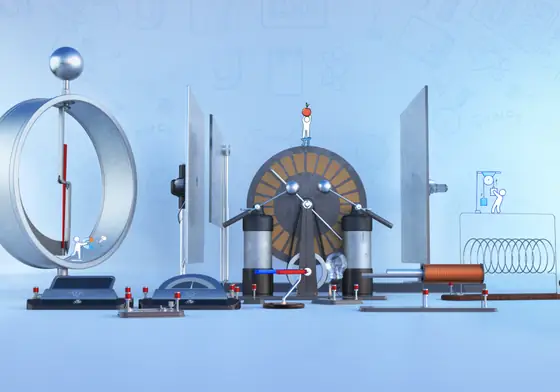
Much of physics deals with things students cannot see: magnetic fields, electric current, the path of light. Diagrams in textbooks help, but they are static. Virtual labs make these ideas visible and let students change them.
Magnetic fields
In the Electromagnetic field lab, students place magnets and conductors and watch field lines appear around them. When they move a magnet, the field redraws instantly. Moving a magnet through a coil induces a current, which makes Faraday's law concrete.
Light and optics
On a virtual optical bench, students move a lens and watch where the image forms. They can measure object and image distances and find the focal length, then check their answer with the lens formula.
Electric circuits
The Electrodynamics lab lets students build circuits with cells, resistors, lamps and meters. They can test series and parallel connections, verify Ohm's law, and see what happens when a circuit is overloaded, without blowing a real fuse.
Forces and motion
The Mechanics lab covers levers, inclined planes, springs and pulleys. Students can measure forces and distances directly and calculate work and efficiency.
Teaching tips
- Ask students to sketch what they expect before they run the simulation.
- Then compare the sketch with what they see. The gap is where learning happens.
- Use the pause and slow-motion controls to discuss each stage of a fast event.
Linking to exams
Exam questions often show a diagram and ask students to predict an outcome. Students who have seen the outcome many times answer faster and more accurately.
Try the physics labs free on vr-labs.ru.